Defending Against Churn Risk with an Ai Focused Strategy
Federato
EXECUTION
Design Strategy • UX • Visual Design • Research
PRODUCT SPACE
B2B SaaS • Series C Insurtech • Workflow Management
ROLE
Head of Design • Leading Team of 4 (3 UX / 1 UXR)

This project reinforced the importance of building user-centered features that offer value beyond aesthetics
Project gallery
Evaluation
The Impact
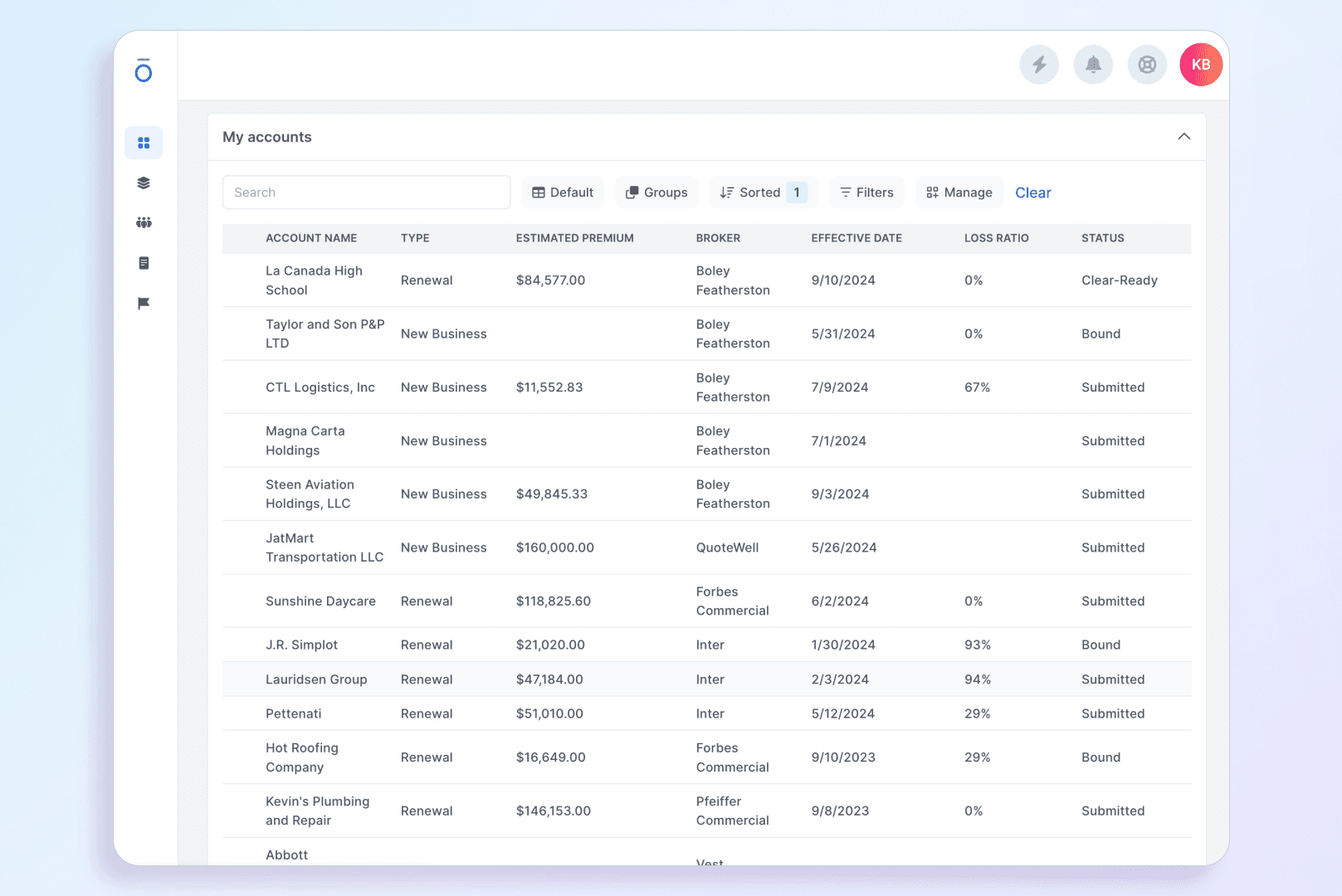
Within months of launch, the redesigned Desk Management experience transformed from a struggling feature into daily launch point for underwriters.
Once we identified our core problem, I led strategy and execution of the solution.
Key Results:
90%+ daily engagement across active users in nearly all customer instances
11% average activity increase, with some instances seeing sharper gains
Reduced churn risk by demonstrating clear platform value
Launched Federato's first AI-enabled feature, paving the way for two additional AI initiatives
For a Series C startup racing toward $10M in revenue, this project proved the platform was mission-critical.
The Problem
Insurance underwriters weren't using our Desk Management dashboard. Usage was low, and user feedback revealed a painful truth:
"Clarity of where to focus effort is low… How do I prioritize submissions? Which are most valuable for me to spend my time on? Right now I just go by which broker is the loudest."
The platform didn't help underwriters make decisions about where to focus their day. So they built their own systems outside our product, threatening both engagement and renewal rates.
The Stakes:
Low engagement signaled lack of perceived value
Churn risk from customers questioning platform ROI
Missed opportunity to differentiate through AI in a competitive market
Taking Initiative
I saw an opportunity where others saw risk.
Despite executive hesitation about "burdening customers" with research outreach, I worked with our user researcher (a role I had advocated for and hired) to plan and conduct targeted interviews with high and low usage cohorts.
The Insight:
Underwriters weren't avoiding the platform because it was hard to use. They were avoiding it because it didn't help inform their analysis. They needed prioritization, context, and confidence, not just better UI.
This insight became the foundation for everything that followed.
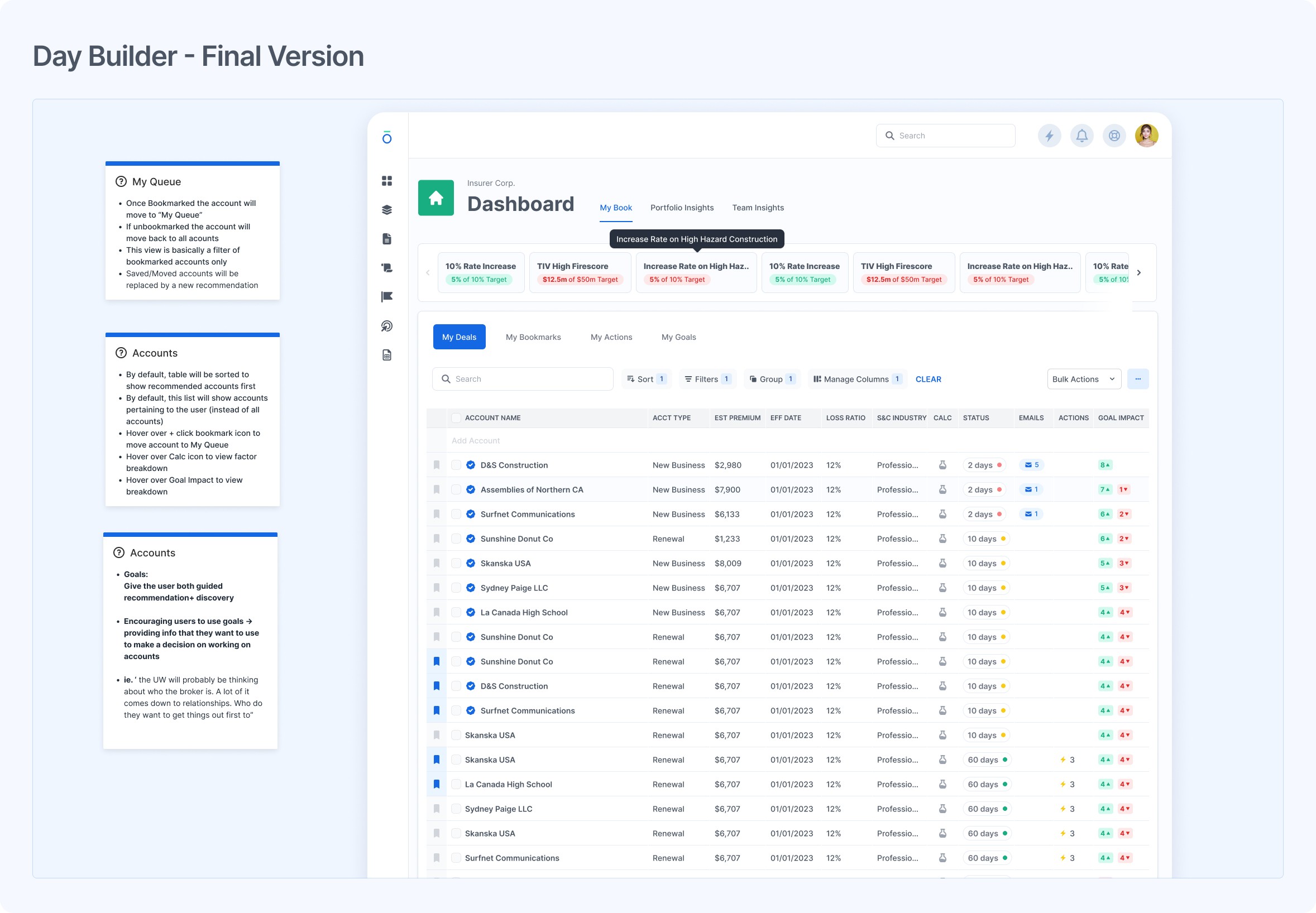
Action
The Approach
I led the team through an intentionally broad exploration phase, testing radically different mental models for organizing daily work.
Exploration: Day Builder Concepts
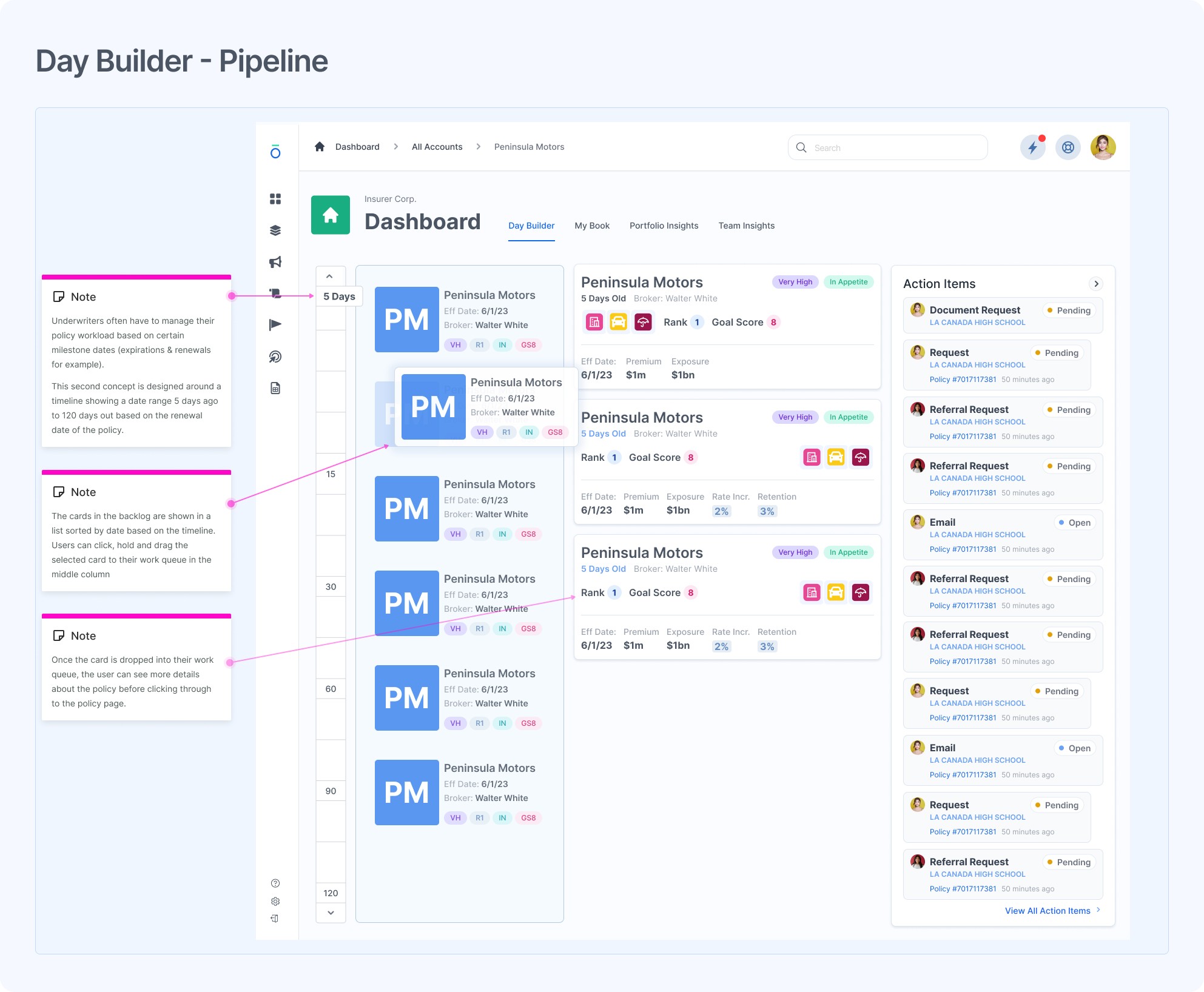
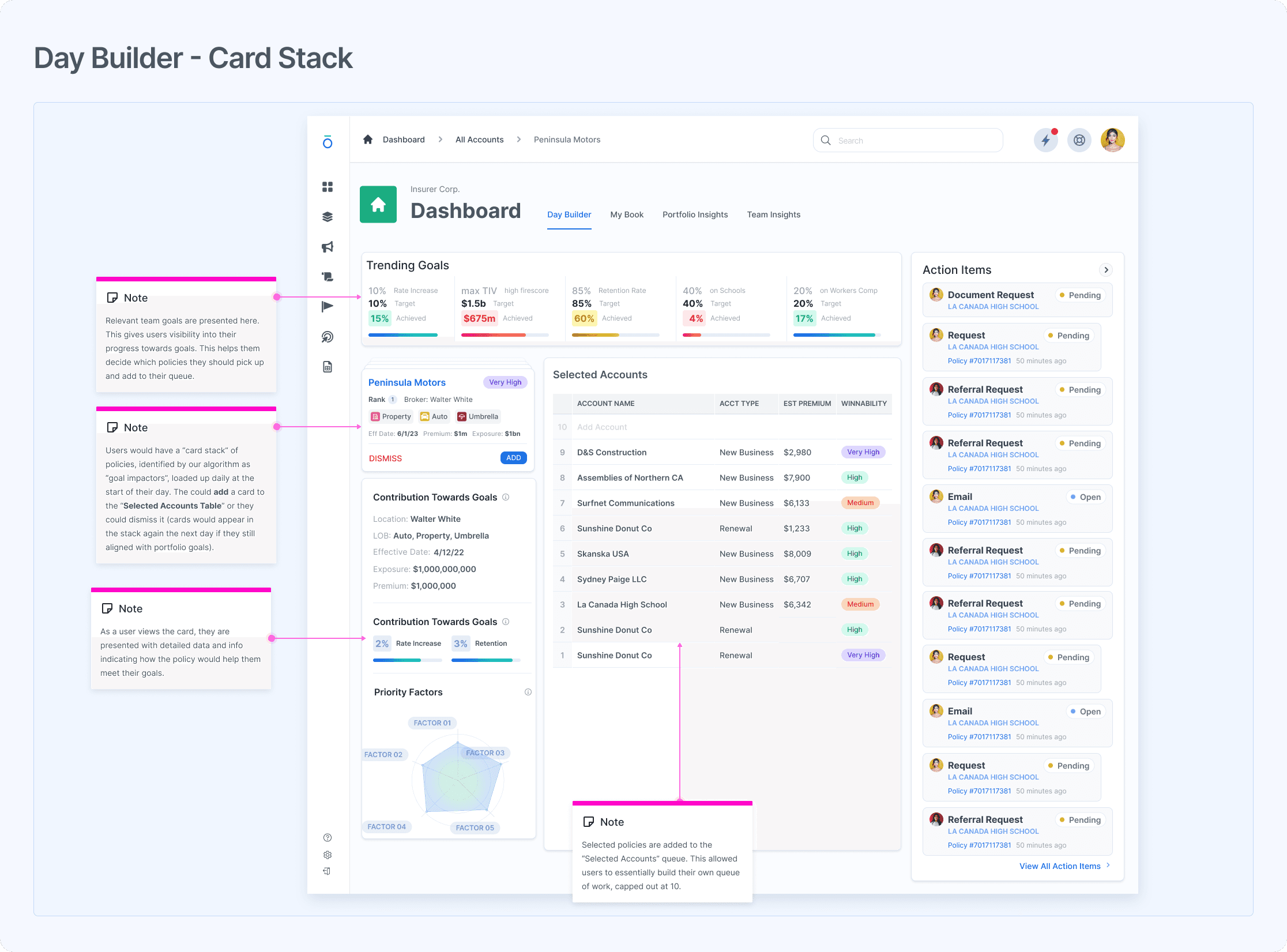
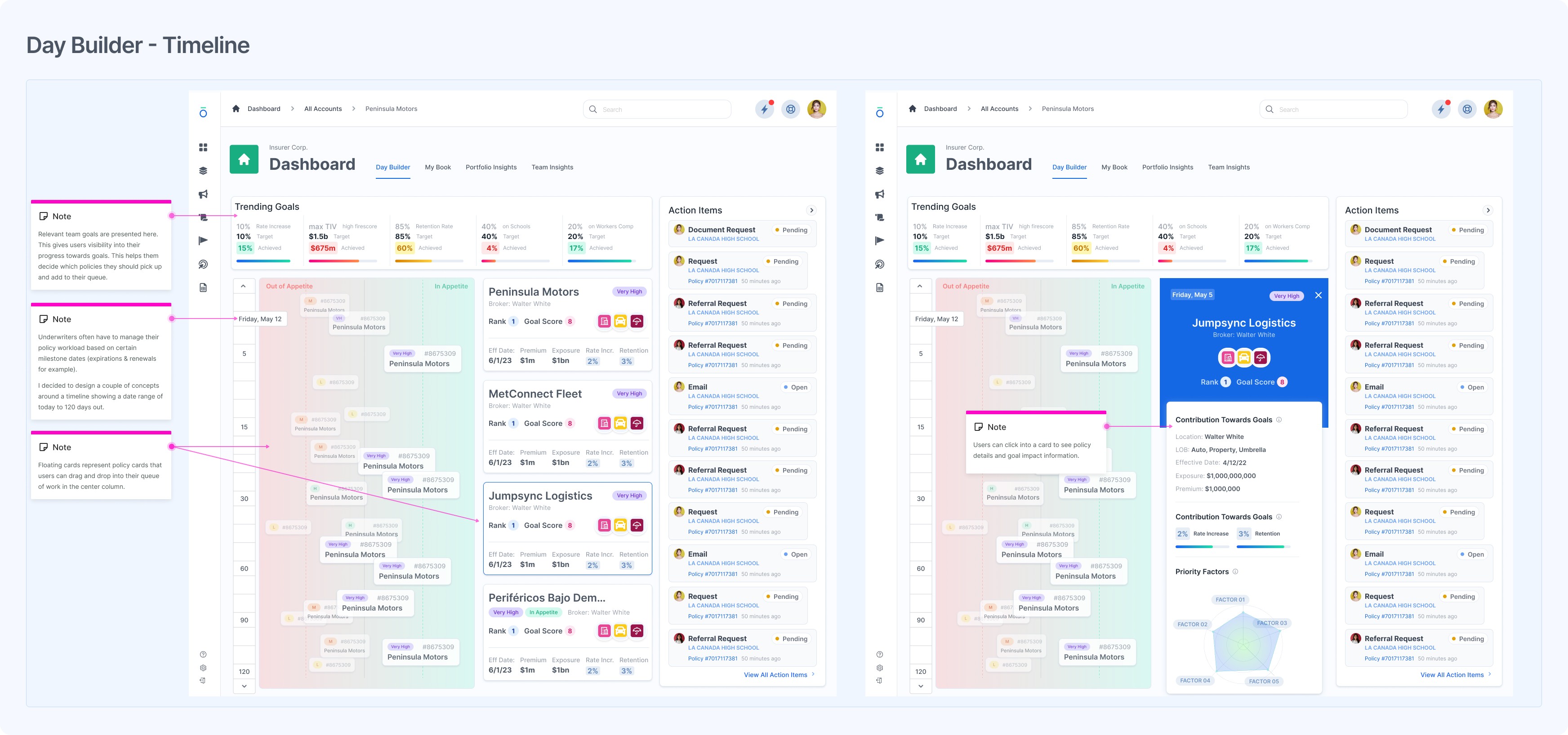
We developed three bold concepts to provoke reactions and surface what mattered most:
Card Stack – Visual, card-based approach to organizing policies by key factors
Timeline – Graph-based view arranging policies by date and appetite alignment
Pipeline – Date-range visualization showing policy renewal timelines
The Pivot: From Static Queue to Dynamic Support
User testing revealed something critical: prioritization data changed daily based on shifting variables: broker activity, appetite fluctuations, policy adjustments.
Underwriters didn't need a better list. They needed decision support that adapted to real-time context.
This drove me to develop two refined concepts:
Decision Support v1
Organized around Accounts, Actions, and Goals, with a "What's Changed?" section to drive daily engagement and broker interaction CTAs.
Decision Support v2
Enhanced with appetite visualization, refined adjustment information, and more detailed broker interaction features.
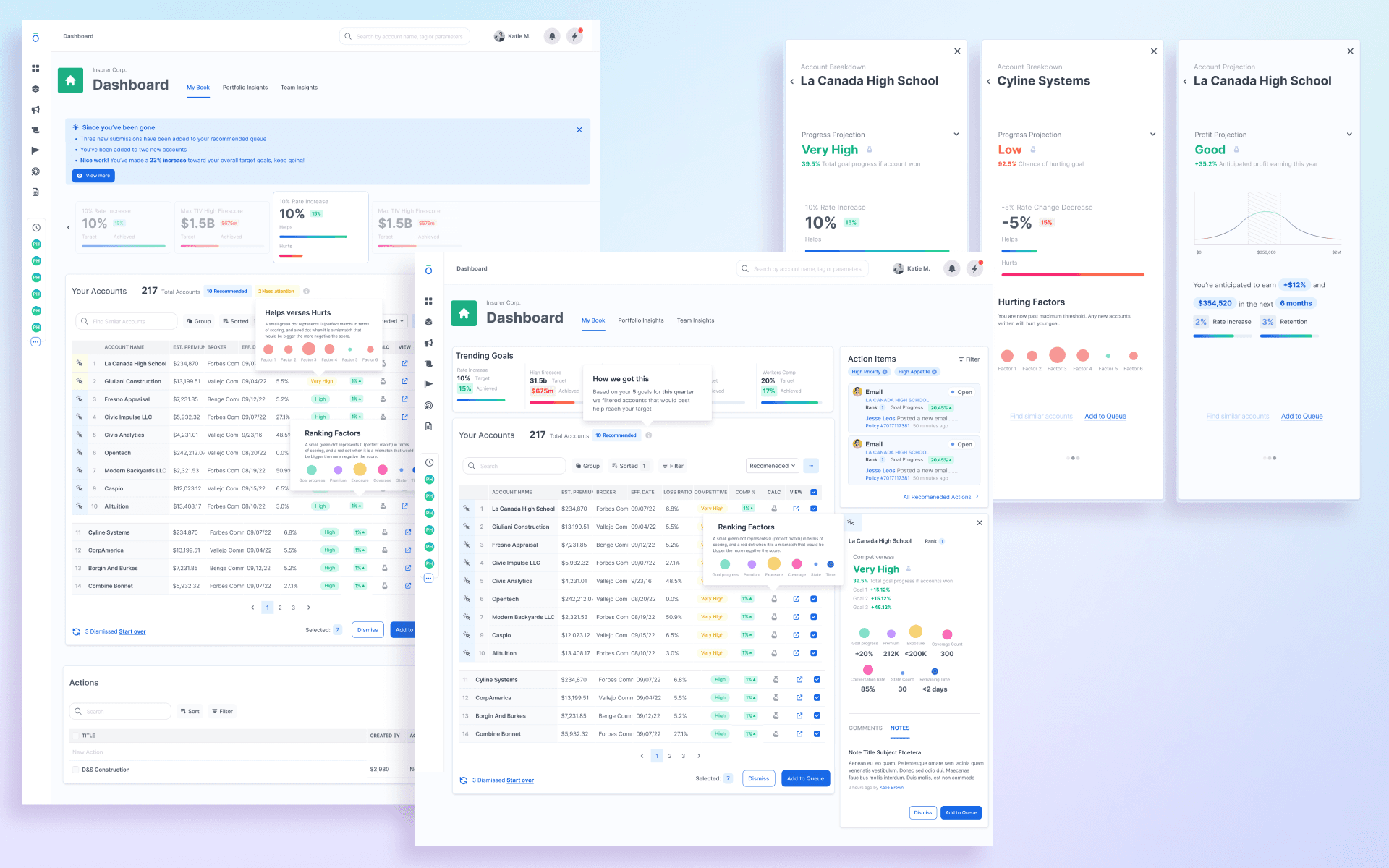
We moved most of the secondary info into components within the table to limit refactoring of interactions and the UI
Navigating AI Sensitivity
Throughout the process, we carefully framed AI as a support, not as a replacement. A tool that helped underwriters make better decisions without replacing their judgment. This was critical for building trust and adoption.
Results
User Adoption
90%+ engagement across active users in nearly all instances
11% net increase in activity rates (only two instances showed minimal change)
Underwriters reported higher confidence in the platform, describing it as a tool they now relied on daily
Business Impact
Addressed churn risk by demonstrating tangible value to end users
Positioned the platform as mission-critical infrastructure for underwriting teams
Supported the company's push toward $10M in revenue by proving ROI
Strategic Influence
Validated the user research function, leading the company to double down on research-driven design
Enabled in-app feedback mechanisms to track impact, creating a flywheel for continuous improvement
Greenlit two additional AI-enabled features based on this success